
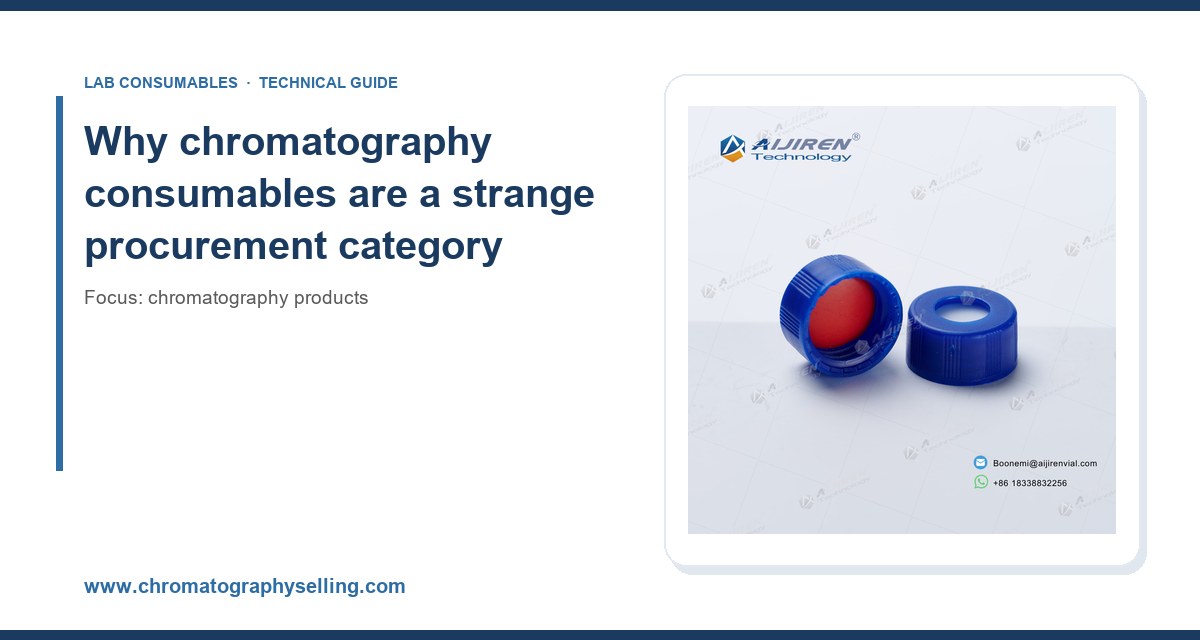
I have bought chromatography consumables for close to fifteen years, and the single most expensive mistake I ever made was not a bad column. It was a supplier who quoted a great per-unit price on 9 mm screw-thread vials, then shipped caps with 1.0 mm silicone liners that coring-punched through in 40 injections instead of the 300 I had budgeted for. The unit price looked 18% cheaper. The real cost per injection was almost triple. That is the whole game in chromatography procurement: the number on the quote is the beginning of the analysis, not the end of it.
This article is about how I actually buy. Pricing structure, minimum order quantities, and a supplier evaluation process that has kept my labs running through two supply-chain shocks. If you are building or auditing a consumables program, these are the levers that matter.
Most lab supply categories behave like office supplies. Chromatography consumables do not. Three things make them different, and all three change how you should negotiate.
First, the consumable is usually a small fraction of the cost of the result it produces. A $2 vial protects a $400 sample preparation and a $150,000 instrument. A $600 column sits inside a method that took three weeks to validate. That asymmetry means the cheapest part is almost never the right part to optimize on price alone. A failed injection costs you rerun time, instrument downtime, and sometimes a data integrity investigation.
Second, the specifications that predict performance are not the ones printed on the invoice. Particle size and pore size matter for columns. For vials, it is glass chemistry, dimensional tolerance, and closure geometry. For filters and syringes, it is membrane material and hold-up volume. You have to ask for the specs, and a good supplier will have them ready.
Third, the category is fragmented. You can buy from the instrument OEM, from a specialty consumables house, from a distributor, or direct from a manufacturer. Each channel has a different cost structure, and the price difference between them for functionally equivalent product is often 30% to 60%. Knowing which channel to use for which item is most of the job.
The four supply channels and what each is actually good for
I source from all four channels. The trick is matching the item to the channel rather than picking one supplier and forcing everything through it.
Instrument OEMs
Agilent, Thermo Fisher, Waters, Shimadzu. You buy here when the method is validated against OEM consumables, when the instrument is under a service contract that requires OEM parts, or when you need a part number that is guaranteed to fit. The Agilent GC columns and accessories catalog and the Thermo Fisher chromatography and sample handling range are the reference points I check first when I need a spec. OEM pricing is the highest of the four channels, typically 1.5x to 2.5x the equivalent from a specialty house. You are paying for validated fit and a single throat to choke.
Specialty consumables manufacturers
Restek, and the manufacturer-direct houses like Aijiren. This is where most of my routine spend goes. The product is often manufactured to the same dimensional standards as OEM, sometimes on the same glass or the same membrane, at a meaningfully lower price. The Restek technical resources are unusually good on things like liner selection and column bleed, and worth reading even if you buy elsewhere. For a manufacturer-direct route, Aijiren is the one I have used most for vials, caps, and syringe filters, largely because they publish dimensional tolerances rather than just a catalog photo.
Distributors and resellers
Useful when you need one PO to cover many brands, or when you are too small to hit a manufacturer MOQ. The distributor takes a margin, usually 15% to 35% on top of what they pay, so you are paying for consolidation and local stock. For a lab buying three or four items a month, that convenience is worth it. For a lab buying 40,000 vials a year, it is money left on the table.
Direct import
Lowest unit price, highest total risk. I use it for high-volume, low-criticality items (vials, caps, generic filters) and never for anything that touches a validated method without a full incoming inspection. More on that below.
How pricing actually works in this category
List price in chromatography consumables is a fiction. Almost everything is discountable, and the discount depends on volume, contract length, and how many line items you bundle. Here is how I think about the real structure.
Unit price versus cost per injection
This is the single most important reframe. Price the consumable per use, not per unit. A 2 mL autosampler vial at $0.18 that you can only use once costs $0.18 per injection. A $0.32 vial with a properly molded PTFE/silicone septum that holds up to 300 punctures costs $0.0011 per injection. The “cheaper” vial is 160 times more expensive per use. I have watched procurement teams fight over three cents on a vial while the lab was throwing away a third of every case on septum coring.
For columns, the metric is cost per injection or cost per sample set. A $650 column that lasts 2,000 injections is $0.33 per injection. A $420 column that lasts 600 injections because the end-fitting frit is poorly sintered is $0.70 per injection. Same logic, opposite conclusion from the quote sheet.
Volume tiers and the MOQ cliff
Most manufacturers price in tiers. A typical structure for 2 mL clear glass vials, 12 x 32 mm, 9 mm screw thread, might look like this:
- 1 to 9 cases (100 vials per case): list price, often $28 to $35 per case
- 10 to 49 cases: 10% to 18% off list
- 50 to 199 cases: 20% to 30% off list
- 200+ cases: 30% to 40% off list, sometimes with freight included
The MOQ cliff is where the real negotiation happens. A manufacturer’s fixed setup cost per SKU is real, so they will often hold a firm MOQ of 10 cases for a standard item and 50 cases for a custom color or a non-standard septum. If your annual volume is below the MOQ, you have three options: buy a year’s stock at once (watch the shelf life), buy through a distributor who consolidates, or negotiate a “mixed pallet” MOQ where you commit to a total dollar value across several SKUs instead of a per-SKU quantity. That last one has saved me more than any single price concession.
What drives the price of a vial, honestly
Glass is not the cost. The cost is dimensional control and the closure. A 12 x 32 mm vial that meets the GPI 9 mm thread standard and holds ±0.2 mm on body diameter and ±0.1 mm on neck height will run you more than one that is “about 12 mm.” The difference shows up at the autosampler: a vial that is 0.6 mm out of tolerance will occasionally fail to seat, and you get a “no vial detected” error mid-sequence. I have seen that error rate sit at 1 in 400 on a cheap lot and 1 in 20,000 on a controlled one. Over a year, that is the difference between a quiet lab and a lab that reruns sequences every week.
The closure is the other half. A 9 mm screw cap with a 1.0 mm silicone/PTFE liner is fine for single injection. For a septum that holds up to 300 punctures without coring, you want a 1.5 mm or 2.0 mm molded septum with a bonded PTFE face, and you want the cap torque to land in a band. I torque 9 mm screw caps to about 0.9 to 1.2 N·m. Below that, the seal leaks and you lose volatiles. Above about 1.5 N·m, you cold-weld the cap to the glass and shear the septum. A torque screwdriver costs $60. Buy one and train the people who cap vials.
A supplier evaluation checklist with numbers
I score every new supplier on the same eight criteria. It takes about two hours of desk work plus one sample lot. Here is the checklist, with the thresholds I actually use.
1. Dimensional and material specs on paper
Ask for the drawing, not the catalog page. For vials: body diameter, height, neck OD, thread standard (GPI 9 mm, GPI 13 mm, GPI 18 mm), glass type (Type I borosilicate for most HPLC and GC work), and residual volume. For caps: septum thickness, septum material, cap material, and the torque range the cap is designed for. A supplier who cannot produce a drawing within 24 hours is a reseller, not a manufacturer, and should be priced accordingly.
2. Certificate of analysis and lot traceability
Every lot should have a CoA with the actual measured values, not just “pass.” For vials, I want to see dimensional measurements and a visual defect rate. For columns, I want retention time and plate count on a test mix. For filters, I want bubble point and extractables data. If the CoA is a template with no numbers, the QC is a template with no numbers.
3. Incoming inspection pass rate
I run a first-article inspection on every new supplier: 30 vials measured with calipers on body diameter and height, 30 caps checked for septum thickness and seating, and a 100-injection puncture test on the septum. Accept if dimensional RSD is under 0.5% and the septum shows no coring at 100 punctures. This test has rejected two suppliers for me in ten years, both on septum thickness running 0.15 mm thin.
4. Lead time and stock position
Ask where the stock sits. Domestic warehouse with 2 to 5 day lead time is the standard for standard items. Direct import is 4 to 8 weeks plus customs. I keep 6 to 8 weeks of safety stock on any item with a direct-import lead time, and 2 weeks on domestic. If a supplier cannot tell you their current stock position on a specific SKU, they are drop-shipping and you will find out the hard way.
5. Change control notification
This is the criterion most buyers forget and the one that hurts most. A supplier who silently changes glass suppliers or septum compound will invalidate your method without telling you. Put a clause in the contract: 30 days’ written notice of any change to material, dimension, or manufacturing site, with a sample of the new lot for re-qualification. I have enforced this clause twice.
6. Quality system
ISO 9001 is the floor. For anything touching a regulated method, I want ISO 13485 or an equivalent, and I want to see the scope statement. A certificate that covers “distribution of laboratory supplies” is not the same as one covering “manufacture of glass vials.”
7. Price stability and currency
Ask for a 12-month price hold and a stated index for any increase. A supplier who will not hold price for a year is telling you they are exposed to glass or resin spot prices, which is fine, but you should know it and budget for it. If you are buying in a foreign currency, ask whether they will invoice in USD and at what exchange rate band.
8. Technical support
Can the person on the phone tell you the difference between a PTFE/silicone and a silicone/PTFE septum, and which face goes toward the sample? If not, they cannot help you troubleshoot a coring problem. Technical support is worth 5% to 10% on price. I have paid it many times.
Comparison: OEM versus specialty versus direct import
Here is the decision table I use for a standard 2 mL, 12 x 32 mm, 9 mm screw-thread vial with a PTFE/silicone septum, at an annual volume of 50,000 vials (500 cases).
- OEM: $0.42 to $0.55 per vial, MOQ 1 case, lead time 2 to 3 days, full documentation, method-validated fit. Best for regulated methods and instruments under contract. Annual cost at $0.48: $24,000.
- Specialty manufacturer: $0.22 to $0.30 per vial, MOQ 10 to 50 cases, lead time 1 to 2 weeks, CoA with measured values, published tolerances. Best for routine work. Annual cost at $0.26: $13,000.
- Direct import: $0.12 to $0.18 per vial, MOQ 200+ cases, lead time 6 to 10 weeks, variable documentation, requires first-article inspection and safety stock. Best for high-volume, non-critical work. Annual cost at $0.15 plus 10% for inspection and carrying cost: about $8,250.
The spread between OEM and direct import is roughly 3x. That is real money, and it is why the channel decision matters more than the negotiating skill. But look at the risk column: the direct-import savings of $15,750 a year disappears if one lot fails first-article inspection and you have to air-freight a replacement. At a $0.48 OEM price you are buying certainty; at $0.15 you are buying a process. Both are legitimate. Match the channel to the criticality of the assay.
Operational precautions that protect the price you negotiated
You can negotiate a great price and lose all of it in the stockroom. These are the controls I insist on.
Storage and shelf life
Septum liners have a shelf life, typically 2 to 3 years from manufacture, and it shortens fast in heat. Store caps below 30°C and out of direct sun. I have seen silicone septa go tacky in a warehouse that hit 40°C in summer, and tacky septa core. Rotate stock first-in-first-out and put the manufacture date on the bin label, not just the case.
Torque and capping
As above: 0.9 to 1.2 N·m for 9 mm screw caps. For 13 mm and 18 mm caps, the band is higher, roughly 1.5 to 2.0 N·m and 2.5 to 3.0 N·m respectively, but always check the manufacturer’s spec. Crimp caps are a different animal: the crimper jaw setting matters more than force, and a jaw that is 0.2 mm out will give you a leak rate you can hear.
Autosampler compatibility
A 12 x 32 mm vial fits most autosamplers, but tray height and gripper clearance vary. Check the draw depth and the vial height tolerance against your instrument’s spec. I have had a lot that was 0.4 mm tall and jammed a gripper on every 50th vial. It is not a vial defect you will catch on a catalog page.
Mixing lots
Never mix septum lots within a validated sequence. If you must, run a system suitability check at the start and end of the run. Lot-to-lot variation in a bonded PTFE face is small but real, and it shows up as retention time drift on volatile analytes.
Troubleshooting checklist for incoming consumables
When something goes wrong, work through this in order. It is the list I hand to new analysts.
- Peak shape changed and retention drifted: check column lot and installation torque on the end fittings. Over-tightening the fitting 0.5 turn past finger-tight crushes the ferrule and creates a dead volume. Re-cut the column and reinstall to finger-tight plus 1/4 turn.
- Ghost peaks in blank: suspect the septum. Run a blank with a new cap. If the ghost disappears, the lot has volatile extractables. Quarantine the lot and request a CoA review.
- Coring and needle blockage: measure septum thickness on 10 caps. If it is under spec by more than 0.1 mm, reject the lot. Check needle gauge and bevel; a 22-gauge blunt needle on a 1.0 mm liner will core in under 50 injections.
- Leaks and lost volatiles: check cap torque with a torque screwdriver. If it is under 0.9 N·m, retrain. If it is over 1.5 N·m, check for cracked necks.
- High background on GC-MS: check column bleed and the inlet liner. A liner that has not been changed in 100 injections is a suspect. Swap it and re-run the blank.
- Filter extractables: if you see new peaks after switching syringe filter lots, run an extractables test with the mobile phase. A 0.22 µm PTFE filter and a 0.22 µm nylon filter are not interchangeable for every mobile phase.
- Vial seating errors: measure body diameter and height on 30 vials. If RSD exceeds 0.5%, reject the lot.
For method-specific acceptance criteria, the U.S. EPA SW-846 test methods are a good reference for what a defensible QC check looks like, even outside environmental work. The structure of the checks is the same.
Where to buy, in practice
My default sourcing map looks like this. For routine vials and caps, I buy from a manufacturer-direct specialty house and hold a mixed-pallet MOQ across three or four SKUs. That is where Vials With Caps and Vial Supplier come in for me: I use them to compare closure options and confirm dimensions before I commit a PO, and the catalogs are specific enough to check a 9 mm thread and a 1.5 mm septum against my method without a phone call. For the full range of columns, syringes, filters, and accessories, I start at Chromatography Products at chromatographyselling.com because the category structure lets me price a whole method rather than a single item. And for anything where I want manufacturer-direct pricing on vials, caps, and filters, Aijiren is the supplier I have qualified most thoroughly, largely on the strength of their dimensional documentation.
For OEM-only items, I stay with the instrument maker. There is no point in saving 40% on a part that voids a service contract.
What I recommend
If you are setting up a chromatography consumables program from scratch, here is the concrete plan I would run.
Start by classifying every item into three tiers. Tier 1 is method-critical: columns, inlet liners, and any vial or septum used in a validated assay. Buy Tier 1 from the OEM or a specialty manufacturer with a full CoA and a change-control clause, and accept the higher price. Tier 2 is routine: general-purpose vials, caps, syringe filters, and autosampler trays. Buy Tier 2 from a manufacturer-direct specialty house at a mixed-pallet MOQ, with first-article inspection on every new lot. Tier 3 is low-criticality, high-volume: wash vials, generic caps, and non-contact consumables. This is where direct import earns its place, with 6 to 8 weeks of safety stock and a documented incoming inspection.
Then set the numbers. Target a 12-month price hold. Negotiate a mixed-pallet MOQ at a total dollar commitment rather than per SKU. Require a drawing and a CoA with measured values within 24 hours of request. Run a 30-vial dimensional check and a 100-puncture septum test on every new supplier and every new lot from a Tier 3 source. Torque 9 mm caps to 0.9 to 1.2 N·m and train everyone who touches a capper. Store septa below 30°C and rotate stock.
Do those things and the price conversation gets much simpler, because you are no longer arguing about unit price. You are arguing about cost per injection, and the supplier who understands that number is the one you want to keep.
The takeaway: in chromatography procurement, the quote is a hypothesis and the first-article inspection is the experiment. Price the consumable per use, match the supply channel to the criticality of the assay, and put the change-control clause in writing before you sign. The supplier who can show you a drawing, a CoA with real numbers, and a stock position is worth a premium. The one who cannot is a line item waiting to become a rerun.
References & further reading
Related resources from our lab consumables network:
- Chromatography Products at chromatographyselling.com
- Aijiren at aijirentech.com
- Vials With Caps at vialswithcaps.com
- Vial Supplier at vialsupplier.com
External references and standards: