
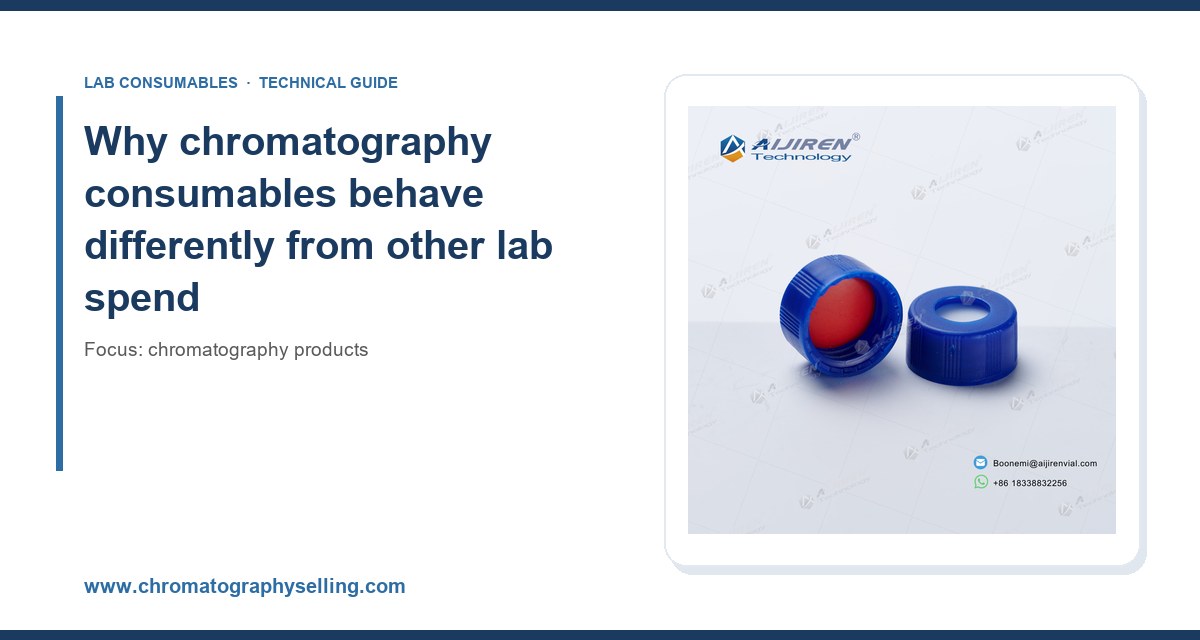
I have sat on both sides of this table. For eleven years I ran purchasing for a contract analytical lab doing EPA-method work, and for the last six I have sold and sourced chromatography consumables. In that time I have watched procurement managers save 30% on a vial order and lose it twice over in failed system suitability runs. I have also seen suppliers quote a landed price that looked 15% cheap until the freight forwarder added a hazmat surcharge. This article is the checklist I wish someone had handed me in year one: how chromatography consumables are actually priced, what MOQ really means once you decode it, and how to qualify a supplier without a six-month audit cycle.
Chromatography consumables are a strange category. The unit costs are small, the failure costs are not. A 2 mL autosampler vial costs somewhere between $0.08 and $0.45 depending on glass grade and cap. A failed sequence caused by a vial with a burred septum or a column with a bad inlet frit can cost you a full shift of instrument time, plus the rerun, plus the analyst’s afternoon. On an LC-MS/MS running 200 samples a day, one lost shift is worth more than a year of vials.
That asymmetry drives everything about how you should buy. You are not really buying glass and PTFE. You are buying the guarantee that the 96th injection in a sequence behaves like the first. Suppliers who understand this price accordingly, and the ones who do not are usually the ones whose product you will be replacing at 2 a.m.
The category also splits cleanly into three tiers with different procurement logic:
- Commodity consumables: vials, caps, septa, syringes, filters, tubing, ferrules. Price-sensitive, high volume, easy to dual-source. This is where MOQ negotiation pays.
- Performance consumables: analytical columns, guard cartridges, SPE sorbents, GC liners. Mid-volume, method-locked, qualification-heavy. Switching costs are high because a column change means revalidation.
- Instrument-specific parts: lamp modules, rotor seals, detector flow cells. Low volume, single-source by design, lead-time driven. You buy availability, not price.
Treat all three the same way and you will either overpay on vials or get stranded on a column. The rest of this article works through pricing structure, MOQ mechanics, supplier evaluation, and a working checklist you can paste into a tender document.
How chromatography consumable pricing is actually structured
The list price is a fiction
Almost no chromatography consumable sells at list. Distributors work on tiers, and the tier you land in depends on annual committed volume, payment terms, and how many product lines you buy from them. A typical structure for a mid-size lab buying $80,000 to $250,000 a year across vials, columns, and filters looks like this:
- Tier 1 (list): what you pay on a one-off web order. Nobody serious pays this.
- Tier 2 (contract): 12% to 22% off list, tied to a 12-month volume commitment with quarterly true-up.
- Tier 3 (strategic): 25% to 35% off list, usually requires consolidating two or three vendors into one and committing to forecast accuracy within ±15%.
The gap between Tier 2 and Tier 3 is where most of the money is. I have seen labs leave $18,000 a year on the table because they spread purchases across four distributors to avoid “putting all eggs in one basket.” Dual-source the critical items, consolidate the rest.
What drives the unit price
For vials specifically, four things move the number:
- Glass grade: Type I borosilicate (USP United States Pharmacopeia Type I, ISO 3585) versus Type II treated soda-lime. Type I costs more and is what you want for pH-sensitive analytes and any LC-MS work. Type II is fine for many GC autosamplers but leaches at high pH.
- Dimension tolerance: a 12 x 32 mm vial that is 0.3 mm out of spec will jam a tray of 100. Good suppliers hold ±0.1 mm on body OD and ±0.2 mm on height. Ask for the incoming inspection data, not the catalog drawing.
- Cap and septum: a polypropylene screw cap with a silicone/PTFE septum is the workhorse. The septum is where the cost lives. A 1 mm silicone/PTFE septum punctures cleanly 3 to 5 times before coring becomes a risk; a 0.9 mm or 1.0 mm PTFE-faced septum on a crimp cap can take more, but the trade-off is needle life.
- Cleanliness: “certified” vials are washed and lot-tested for background. The premium is real, typically 20% to 40%, and it is worth it for trace analysis at ppb levels. For a prep HPLC method running at mg/mL, it is not.
For columns, price tracks particle size, dimensions, and bonded phase. A 4.6 x 150 mm, 5 µm C18 column from a major brand sits in the $350 to $550 range; the same dimensions in a 1.8 µm UHPLC particle run $600 to $900. Guard cartridges are where the volume is: budget one guard per 200 to 400 injections and price accordingly.
Hidden line items to model before you sign
The quoted unit price is rarely the landed cost. Build these into your comparison spreadsheet or you will be surprised at invoice time:
- Freight and hazmat: solvent-containing items and some reference standards carry surcharges. On a $5,000 order, freight can add 3% to 8%.
- Cold chain: enzymes, some SPE sorbents, and certain standards ship on dry ice. Add $40 to $120 per shipment if you are not consolidating.
- Currency exposure: if you buy imported columns, a 5% currency swing on a $200,000 annual spend is $10,000. Ask whether pricing is fixed in USD or indexed.
- Payment terms: net 30 versus net 60 is worth roughly 1% to 2% of annual spend in working capital. Do not trade that away for a 1% discount.
MOQ: what it really means and how to negotiate it
MOQ is the most misunderstood number in consumables procurement. A supplier quoting “MOQ 50 cases” is telling you something about their manufacturing batch size, not their willingness to sell you five. Decode it before you push back.
The three MOQ layers
- Manufacturing MOQ: the batch size the factory runs. For a vial, this might be 10,000 to 50,000 units per SKU per run. You will never hit this alone, so you buy from distributor stock.
- Distributor MOQ: the minimum the distributor will ship without a restocking fee. Often 1 to 5 cases (a case of 2 mL vials is typically 100 to 200 units).
- Contract MOQ: the annual committed volume behind your discount tier. This is the one that actually matters and the one you can negotiate.
When a supplier says “MOQ 20 cases,” ask which layer they mean. Nine times out of ten it is a distributor policy, and a phone call gets it to 5. If it is a true manufacturing MOQ, ask whether they hold buffer stock of that SKU and whether you can buy against it.
Negotiation levers that work
I have closed dozens of these. The levers that move MOQ and price, in order of effectiveness:
- Forecast commitment: offer a 12-month rolling forecast with a ±20% band. Suppliers will drop MOQ 50% for a credible forecast because it lets them plan production.
- Consolidation: move vials, caps, and filters to one supplier. A $60,000 combined line gets better terms than three $20,000 lines.
- Standardize on GPI thread: the GPI 13-425 and GPI 18-400 thread standards mean caps from multiple vendors fit the same vial. Standardizing on one thread across your methods lets you dual-source without revalidating, which gives you leverage.
- Take the buffer stock: if a supplier has slow-moving SKUs, offer to buy a quarter’s worth up front at a discount. You get price, they get inventory relief.
- Pay early: a 2% discount for net 10 is common and often better than the financing cost of holding cash.
When a low MOQ is a warning sign
Not always good news. A supplier willing to break a case into singles is doing manual repacking, which means the vials left a cleanroom and went into a warehouse bin. For trace-level work, that is a contamination risk. I have seen background counts jump 5x on repacked vials versus factory-sealed cases. If you need singles, buy from a supplier who ships factory-sealed inner packs, not loose units.
How to evaluate a chromatography consumables supplier
Most supplier scorecards are theater. They measure on-time delivery and price, which are lagging indicators, and ignore the things that actually cause you pain. Here is what I check, in the order I check it.
1. Technical documentation, not marketing copy
Ask for three documents before you place a trial order:
- Certificate of analysis for the specific lot, with the test methods named. If they cannot produce a CoA with a lot number, they are a trader, not a manufacturer.
- Dimensional inspection data for vials and caps. You want to see the actual measured range against the drawing, not a nominal spec.
- Extractables or background data for anything touching your sample path. For LC-MS vials, a background scan at the relevant m/z is table stakes.
Suppliers who manufacture in-house publish this. Suppliers who white-label often cannot. That distinction matters more than the logo on the box.
2. Lot-to-lot consistency
The single biggest failure mode in consumables is not a bad lot, it is a variable one. A column that performs at 98% of reference on lot A and 91% on lot B will wreck your system suitability. Ask for retention time and peak area RSD data across three consecutive lots. For a C18 column, you want retention time RSD under 1.5% and area RSD under 2.0% across lots on a standard test mix. If they cannot show it, assume it does not exist.
3. Lead time and stock position
Ask specifically: “Is this SKU stocked in your warehouse, or drop-shipped from the factory?” The answer changes your lead time from 2 days to 6 weeks. For method-critical columns, hold one spare in inventory at all times. For vials, a 4 to 6 week buffer is enough if you have a reliable supplier.
4. Quality system and traceability
ISO 9001 is the floor. For anything used in a regulated lab, ask about ISO 17025 for the testing lab and whether the supplier’s CoA is generated under their own quality system or a third party’s. Traceability from lot number back to raw glass and resin batch is what lets you do a recall investigation in hours instead of weeks.
5. Commercial responsiveness
I test this before I sign anything. Send a technical question with a specific number in it (for example, “what is the maximum autoclave temperature for your PP caps?”) and time the response. A good supplier answers in under 24 hours with a number. A bad one sends a brochure. You will need that responsiveness at 4 p.m. on a Friday when a method is failing.
Supplier comparison checklist
Here is the scorecard I use. Weight the criteria, score each supplier 1 to 5, and multiply. It takes 30 minutes per supplier and saves months.
- Documentation (weight 25%): CoA with lot, dimensional data, background/extractables data. Score 5 if all three are on file before you ask twice.
- Consistency (weight 20%): three-lot RSD data, retention time RSD under 1.5%, area RSD under 2.0%.
- Lead time (weight 15%): stocked SKUs at 2 to 5 days, factory items at 4 to 6 weeks, with a stated stock position.
- Quality system (weight 15%): ISO 9001 minimum, ISO 17025 for testing, full lot traceability.
- Price and terms (weight 15%): landed cost including freight, tier discount, payment terms, MOQ flexibility.
- Responsiveness (weight 10%): sub-24-hour technical reply with a number, named account contact.
A supplier scoring under 3.5 weighted is a backup, not a primary. A supplier scoring 4.5 or above on documentation and consistency is worth paying a premium for.
Operational precautions that affect what you should buy
Procurement decisions get better when you understand how the product fails in the lab. Three examples from my own experience.
Septum coring and needle life
A septum that cores at the third injection sheds a fragment into the vial, and that fragment goes into the column. The fix is not a better septum alone; it is matching septum thickness to needle gauge. A 0.9 mm silicone/PTFE septum is fine for a 22-gauge needle. For a 26-gauge needle on a low-volume LC-MS method, use a thinner septum and a pre-slit cap. Pre-slit caps reduce coring but increase evaporation; for a 12-hour sequence, evaporation on a pre-slit cap can be 2% to 4% of a 100 µL sample. Weigh that against your run length.
Autosampler tray fit
A vial that is 0.3 mm oversize will lift in the tray and the needle will miss. This is a dimensional tolerance problem, not a supplier quality problem in the abstract. Specify 12.0 ± 0.1 mm body OD and 32.0 ± 0.2 mm height, and verify with a go/no-go gauge on receipt. A $40 gauge saves a $4,000 instrument repair.
Column backpressure and frit selection
Inlet frit porosity drives backpressure more than most people realize. A 0.5 µm frit protects the bed better but raises backpressure 15% to 25% versus a 2 µm frit. On an older HPLC with a 400 bar limit, that difference can push you into a pressure shutdown. Match the frit to your system’s pressure headroom, not to the marketing sheet. For UHPLC at 1000+ bar, the frit choice is part of the method, and switching suppliers means re-qualifying.
Troubleshooting checklist for a failing consumable batch
When a batch misbehaves, work through this in order. I have used it to isolate the cause in under an hour more times than I can count.
- Check the lot number: is this a new lot? If yes, quarantine it and pull a retained sample from the previous lot.
- Run a system suitability standard: if it passes, the problem is the sample or the vial, not the column.
- Inspect 10 vials from the case: look for burrs on the neck, uneven septum seating, and visible particulates. A magnifier and a bright light are enough.
- Measure dimensions: go/no-go gauge on OD and height. Reject the case if more than 1 in 50 is out.
- Check septum puncture count: if the method reinjects from the same vial more than 3 times, coring is the likely cause. Switch to a pre-slit cap or a fresh vial per injection.
- Run a blank injection: a background peak at the analyte retention time points to extractables. Compare against a certified-clean vial.
- Check backpressure trend: a rising trend over 50 injections points to frit loading, not the column bed. Swap the guard and re-test.
- Confirm storage conditions: vials stored above 30 °C or in humid rooms can have cap liner adhesion failures. Check the warehouse, not just the lab.
If two or more of these point at the same lot, escalate to the supplier with the lot number and your data. A good supplier will replace the lot and investigate. A bad one will blame your method. That response is itself a qualification data point.
Where to source and how to structure the buy
For commodity consumables, the practical answer is to build a two-supplier structure: a primary for price and a secondary for continuity. For vials and caps specifically, I keep a primary on a vial supplier that stocks factory-sealed cases and publishes dimensional data, and a secondary for overflow. For caps and septa, standardizing on GPI thread means you can move between vials with caps from different manufacturers without revalidating the autosampler method. That single decision, standardizing the thread, is worth more negotiation leverage than any single discount you will win.
For columns and performance consumables, the calculus is different. You are buying method continuity. Stick with the brand your method was validated on unless you are prepared to revalidate. If you are building a method from scratch, the technical resources at Restek and the application libraries from Agilent and Thermo Fisher will save you weeks of method development. For EPA-method work, the SW-846 test methods define the consumable requirements precisely, and you should buy to those specs rather than to a distributor’s recommendation.
For a broad catalog of chromatography consumables with published specs, chromatography products at chromatographyselling.com is a reasonable starting point for price benchmarking, and Aijiren is worth a look for high-volume vial and filter supply where you want factory-direct pricing and lot traceability. I have sourced from both and the documentation held up.
A worked example
A lab running 150 LC-MS samples a day, 5 days a week, uses roughly 39,000 vials a year. At a Tier 2 price of $0.18 per certified vial, that is $7,020. Moving to Tier 3 at $0.14 saves $1,560 a year. The bigger win is the guard cartridges: at one guard per 300 injections and 39,000 injections, that is 130 guards at $45 each, or $5,850. Negotiating guard pricing and extending guard life by 20% through better sample prep saves more than the vial discount. That is the kind of analysis a good supplier will help you do, and a bad one will not.
Takeaway
Chromatography consumables procurement is a documentation exercise more than a price exercise. Get the CoA, the dimensional data, and the three-lot RSD numbers before you sign. Standardize on GPI thread so you can dual-source without revalidating. Negotiate MOQ against a forecast, not against a single order. And model the landed cost including freight, cold chain, and payment terms, because the quoted unit price is the least interesting number on the page. A supplier who answers a technical question with a number in under 24 hours is worth a 10% premium. A supplier who sends a brochure is worth replacing.
References & further reading
Related resources from our lab consumables network:
- Chromatography Products at chromatographyselling.com
- Aijiren at aijirentech.com
- Vials With Caps at vialswithcaps.com
- Vial Supplier at vialsupplier.com
External references and standards: