
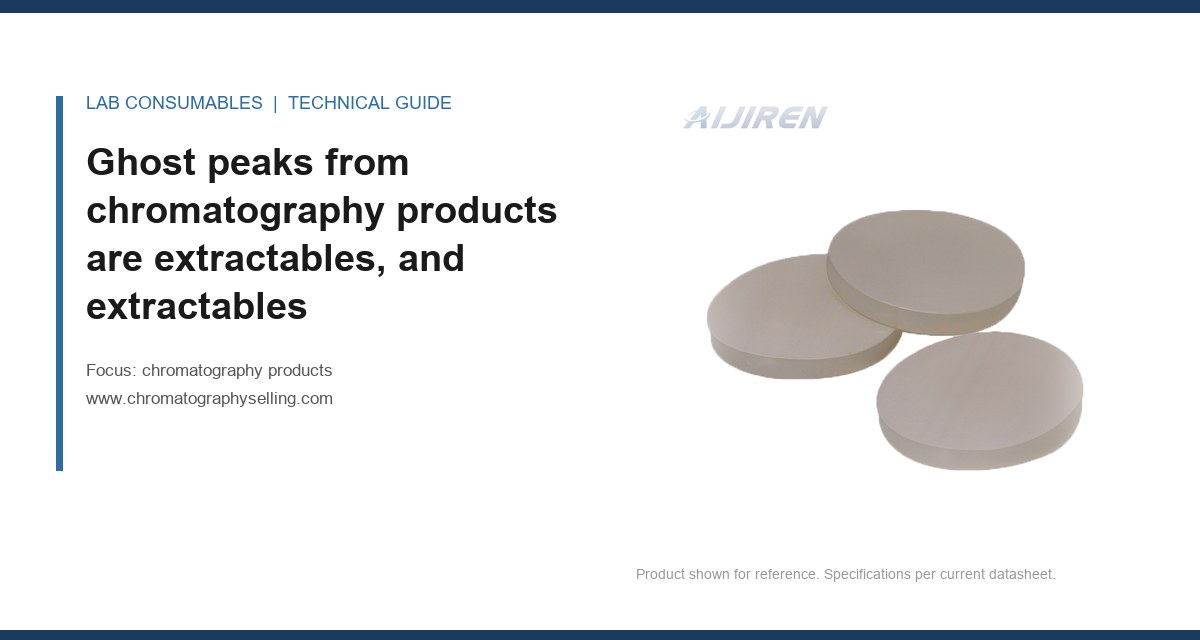
A 30 m × 0.25 mm × 0.25 µm GC column that had run clean blanks for eleven months suddenly showed a 0.8 pA rise in baseline and three ghost peaks at 14.2, 16.8, and 21.5 minutes, each around 0.4 to 0.6 µg/mL equivalent, appearing only in sample runs and never in solvent blanks. The instrument was fine. The column was fine. The source was a bag of septa from a new lot, and the contamination was a siloxane bleed that only showed up when the inlet was hot and the needle punctured the septum. That is the shape of most chromatography products ghost peaks, extractables and contamination problems: they are material-sourced, temperature-dependent, and invisible to the blank you are probably running. This article is about finding them.
Ghost peaks from chromatography products are extractables, and extractables have a temperature threshold
Every polymeric component in the flow path releases something. Septa, ferrules, O-rings, vial septa, inline filters, tubing, and even the cap liner on your autosampler wash vial are all formulated with plasticizers, antioxidants, curing agents, and low-molecular-weight oligomers. Those compounds sit in the polymer matrix until heat or solvent mobilizes them. Then they enter the carrier gas or the mobile phase and land on the column as peaks you did not inject.
The key variable is the desorption temperature, not the injection volume. A septum that is quiet at an inlet temperature of 200 °C can throw a 1.5 pA bleed at 280 °C within twenty injections. The same is true on the LC side: a PEEK ferrule that is inert in 40 °C water/acetonitrile will leach oligomers into 60 °C methanol/water at pH 2. Temperature ratings on the datasheet are a starting point, not a guarantee, because they are usually quoted for a single solvent and a single contact time.
I have watched a lab chase a “column contamination” for two weeks when the actual source was the PTFE-lined silicone cap liner on the autosampler wash bottle. The wash solvent was 90:10 acetonitrile/water, the cap sat at 35 °C, and the liner was not rated for continuous acetonitrile contact. The liner swelled, the silicone face contacted the solvent, and a phthalate plasticizer (DEHP, confirmed by GC-MS at m/z 149) appeared as a broad hump at 22 minutes in every tenth injection. Changing the cap to a PTFE-faced silicone with a bonded barrier eliminated it. The column was never the problem.
Which material bleeds what, and at what temperature
This is the table I wish every lab manager had pinned above the GC. It is not exhaustive, but it covers the materials that account for most of the contamination I have seen in fifteen years of running a consumables operation.
| Component / material | Typical extractables | Onset temperature (GC) or condition (LC) | Detection signature |
|---|---|---|---|
| Silicone rubber septum (general purpose) | Cyclic siloxanes (D4–D8), phthalates, curing byproducts | Bleed rises sharply above 250 °C inlet; measurable from 220 °C | Homologous series of peaks at m/z 73, 207, 281; baseline rise |
| PTFE-faced silicone septum | Reduced siloxane; residual PTFE sintering aids | Stable to 300 °C inlet; PTFE face prevents needle-side contact | Much lower siloxane; occasional fluorocarbon at m/z 69 |
| Graphite ferrule | Graphite fines, sulfur traces | Any temperature; fines migrate with carrier gas | Spiky baseline, sulfur peaks (m/z 32, 64) if contaminated |
| Vespel/graphite ferrule (85/15) | Vespel oligomers, imide fragments | Above 350 °C; also degrades with repeated retightening | Peaks at m/z 78, 104, 128; slow baseline drift |
| PEEK tubing / ferrules (LC) | Oligomers, residual monomers | Above 60 °C or in strong aprotic solvents (DMSO, THF) | Broad humps in UV at 210–230 nm; MS background at m/z 300–600 |
| Vial septum, silicone/PTFE | Siloxanes, plasticizers from cap liner adhesive | Headspace above 80 °C; also with long autosampler residence | Ghost peaks in HS-GC; phthalate at m/z 149 |
| Inline solvent filter (cellulose/regenerated) | Cellulose fines, wetting agents | First 50–100 mL after install | Particulate spikes; UV baseline noise at 200 nm |
| Polypropylene autosampler vial | Oligomers, antioxidants (BHT, Irgafos) | Above 40 °C or with chlorinated solvents | Peaks at m/z 205, 219, 441; yellowing on storage |
Two things to notice about this table. First, the onset temperatures are lower than most datasheets claim, because datasheets quote the maximum continuous-use temperature, not the temperature at which extractables become analytically visible at sub-ppm levels. Second, the LC materials (PEEK, polypropylene) are solvent-sensitive, not just temperature-sensitive, and the solvent that causes the most trouble is usually the one you use for needle wash or sample diluent, not the mobile phase itself.
Isolating the source with blank and placebo injections
The single biggest mistake I see is running a solvent blank and declaring the system clean. A solvent blank tests the mobile phase and the injection path up to the needle. It does not test the septum, the vial, the cap, or the sample matrix. You need three injections, not one, and you need to run them in a specific order.
The three-blank sequence
- Blank 1: system blank. Inject the mobile phase or carrier gas with no vial, no needle puncture (use a bypass or a zero-volume injection). This establishes the instrument baseline. If ghost peaks appear here, the problem is in the column, the inlet, or the detector, not the consumables.
- Blank 2: vial blank. Inject the same solvent from a fresh vial with a fresh septum and cap. If peaks appear here but not in Blank 1, the source is the vial, septum, or cap. This is where most chromatography products ghost peaks live.
- Blank 3: placebo. Inject the sample matrix without the analyte (the excipient, the buffer, the derivatization reagent). If peaks appear here but not in Blanks 1 and 2, the source is the matrix reacting with a consumable, for example a derivatization reagent attacking the septum or a high-pH buffer attacking the PEEK.
Run all three in triplicate, at the same injection volume and the same inlet temperature as your sample method. Do not run the blanks at a lower temperature “to save the column.” The whole point is to reproduce the thermal conditions that mobilize the extractables.
Placebo design for LC and for GC
On the LC side, the placebo is the reconstitution solvent plus any derivatization reagent, injected through the same vial and cap as your samples. On the GC side, the placebo is the matrix blank: the soil extract, the blood plasma, the polymer dissolved in solvent, with no analyte. For headspace GC, the placebo is the matrix plus the same volume of water or diluent, sealed in the same vial with the same septum, equilibrated at the same temperature. I have seen headspace ghost peaks appear only when the equilibration temperature exceeded 90 °C, because that was the point at which the cap liner adhesive began to off-gas. The placebo reproduced it; the solvent blank did not.
Confirming the source with a swap test
Once you have a suspect, swap one component at a time and re-run Blank 2. Change the septum lot, then the vial lot, then the cap lot. If the ghost peaks disappear when you change the septum but not the vial, you have your answer. This is the same logic as a clinical trial: one variable at a time, and a control that is identical in every other respect. The swap test takes about two hours and saves you two weeks of column replacement.
Field case 1: the septum lot that only failed at 270 °C
Symptom: A GC-FID method for residual solvents in pharmaceutical excipients developed a baseline rise of 0.6 pA and three ghost peaks (14.2, 16.8, 21.5 min) after about 200 injections on a new septum lot. The solvent blank was clean. The column had been replaced twice.
Measurement: Blank 2 (vial blank) reproduced the peaks. A swap test with a retained sample of the previous septum lot eliminated them. GC-MS of the ghost peaks showed a homologous series at m/z 73, 207, 281, consistent with cyclic siloxanes. The new lot had a higher volatile content (the certificate of analysis listed 0.4% vs 0.1% for the previous lot) and a slightly different cure, which raised the bleed onset from about 240 °C to about 260 °C. The method ran the inlet at 270 °C.
Fix: Switched to a PTFE-faced silicone septum rated to 300 °C, and added a lot-release check: a 10-injection blank run at the method inlet temperature, with an acceptance criterion of no peak greater than 0.1 pA above baseline in the 14–22 minute window. That check now runs on every incoming septum lot. The cost is about 40 minutes of instrument time per lot; the savings is not replacing columns.
Field case 2: the vial cap liner that leached into a 60 °C LC method
Symptom: An LC-UV method for a small-molecule API at 220 nm showed a broad hump at 18–20 minutes, growing over three weeks, only in sample runs. The mobile phase blank was clean. The column was new.
Measurement: Blank 2 (vial blank, 90:10 acetonitrile/water at 60 °C) reproduced the hump. LC-MS of the hump showed m/z 149 and 167, consistent with a phthalate plasticizer. The cap liner was a silicone-faced liner with an adhesive layer, and the adhesive was not rated for continuous acetonitrile contact at 60 °C. The liner had swollen and the adhesive had begun to migrate into the vial headspace.
Fix: Switched to a PTFE-faced silicone liner with a bonded barrier (no adhesive layer) and moved the autosampler tray temperature from 60 °C to 25 °C. The hump disappeared within one run. The lesson: the autosampler tray is a heated compartment, and every cap liner in it is being extracted in real time.
Operational precautions that actually prevent contamination
Most of the prevention is in the purchasing and the incoming check, not in the troubleshooting. Here is what I would put in a standard operating procedure.
- Specify the extraction temperature, not just the maximum use temperature. Ask the supplier for the bleed onset temperature at your method inlet temperature, and for the volatile content on the certificate of analysis. A septum rated to 300 °C with 0.5% volatiles is worse than one rated to 280 °C with 0.05%.
- Condition new septa before use. Hold at 250 °C for 30 minutes under carrier gas with the column disconnected (or with a guard column in place). This drives off the surface volatiles before they reach the column.
- Match the cap liner to the solvent and the temperature. PTFE-faced silicone for acetonitrile and methanol; PTFE/silicone with a bonded barrier for heated trays; avoid adhesive-lined liners above 40 °C. For a wider selection of vials and caps with documented liner specifications, see Vials With Caps.
- Use the shortest needle residence time you can. A septum that is punctured and left in the inlet for 30 seconds at 280 °C bleeds more than one that is punctured and withdrawn in 2 seconds. Autosampler dwell time matters.
- Change the inlet liner on a schedule, not on a symptom. A liner with 200+ injections of dirty matrix is a contamination source in its own right. I use 100 injections for dirty matrices, 200 for clean ones.
- Flush new LC inline filters. 100 mL of mobile phase to waste before connecting the column. This removes cellulose fines and wetting agents.
- Keep a retained sample of every septum, vial, and cap lot. When a ghost peak appears, the swap test needs a known-good control. Without a retained sample, you are guessing.
For GC-specific consumable selection, the technical notes from Restek and the column and accessory documentation from Agilent both publish bleed profiles by septum type and inlet temperature, which is more useful than a generic “low bleed” claim. For LC sample handling and vial selection, Thermo Fisher publishes liner and cap compatibility tables by solvent class. The EPA SW-846 methods specify container and septum requirements for volatile organics, and those requirements exist because someone already had this problem.
Decision rule: isolate the material before you replace the column
When ghost peaks appear, run the three-blank sequence before you touch the column. If Blank 2 reproduces the peaks, the source is a consumable (vial, septum, cap, or filter), and the fix is a material swap, not a column replacement. If Blank 3 reproduces them, the source is a matrix-material interaction, and the fix is a liner or material change. If only Blank 1 shows them, the problem is in the instrument, and the consumables are innocent. The rule is: one blank, one variable, one swap. A retained sample of every lot and a 10-injection blank check at the method inlet temperature on every incoming septum and cap lot will catch most of these before they reach a validated run. For a broader view of the consumable categories involved, the product range at Chromatography Products and the manufacturing background at Aijiren are useful starting points, and a vial supplier with documented liner specifications, such as Vial Supplier, will save you the swap test entirely.
References & further reading
Related resources from our lab consumables network:
- Chromatography Products at chromatographyselling.com
- Aijiren at aijirentech.com
- Vials With Caps at vialswithcaps.com
- Vial Supplier at vialsupplier.com
External references and standards: