
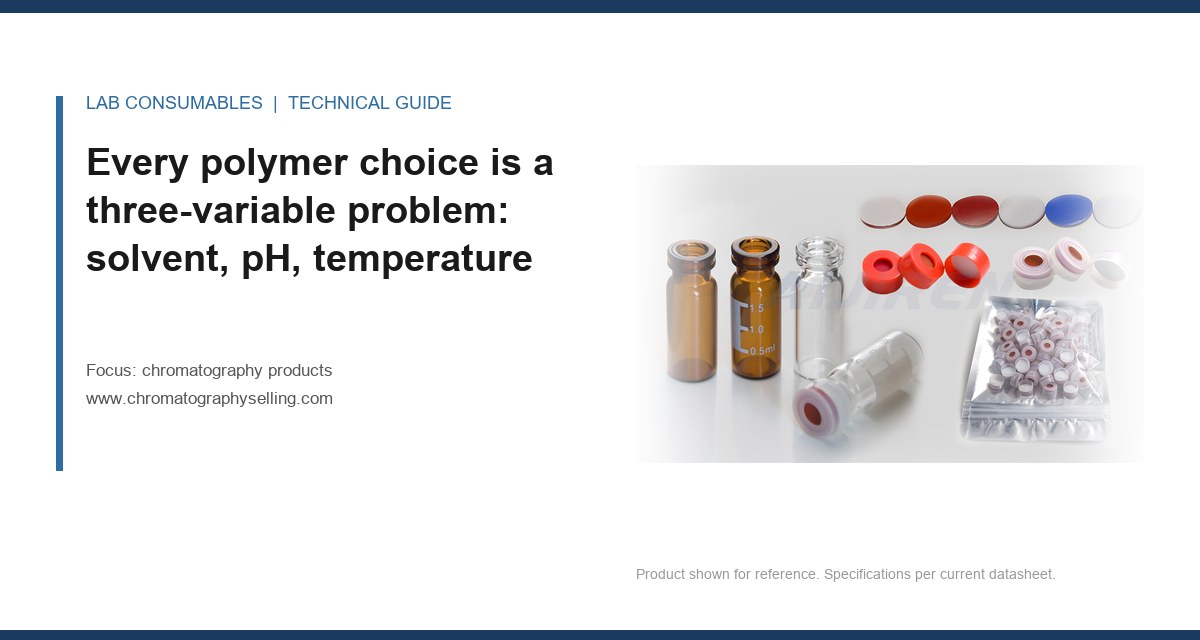
A 96-vial sequence on a 40 °C headspace oven came back with toluene recoveries at 61% RSD 14.2% against a 92% RSD 2.8% check standard. The method was fine. The vials were fine. The septa were silicone-faced, and the silicone had been sitting against a toluene-heavy sample matrix for four hours at temperature. Which chromatography products material to use for a given solvent and temperature is not a catalog question. It is a solubility question with a temperature coefficient, and the wrong answer shows up as a number on a QC chart three weeks later.
I have spent most of fifteen years watching polymer choices fail in ways that look like instrument problems. The pattern is consistent: the analyst blames the column, then the inlet, then the integrator. The actual failure is a septum, a cap liner, a ferrule, or a tubing run that was selected for its dimensions and not its chemistry. This guide is about the chemistry. Sizing and price live elsewhere on this site; I will not repeat them.
You cannot pick a material by name. PTFE, silicone, EPDM and laminate are not categories of quality. They are categories of chemical resistance, and each one has a failure mode that is specific to the solvent class and the thermal window it sees.
The three variables interact. A solvent that swells a polymer at 25 °C may extract it at 60 °C. A pH that is harmless at room temperature may hydrolyse a bond at 80 °C. When you specify a chromatography product, you are specifying a point in that three-dimensional space, and the supplier datasheet usually gives you one axis at a time. The work is combining them yourself.
Start with the solvent. Classify it as aqueous, polar organic, nonpolar organic, halogenated, or acid/base. Then add the temperature the part actually sees (not the method setpoint; the oven, the autosampler tray, the transfer line). Then add the pH of the aqueous phase if there is one. If any of those three numbers is unknown, you are guessing.
PTFE: the default for aggressive chemistry, with two specific weaknesses
Polytetrafluoroethylene is the first answer for most people, and usually the right one. It is inert to nearly every solvent class, stable from about -200 °C to +260 °C continuous, and unaffected by pH across the full 0 to 14 range. For a septum, a liner face, a ferrule, or a transfer line carrying halogenated solvent or concentrated acid, PTFE is the safe default.
It has two weaknesses that matter in chromatography specifically.
Cold flow and the seal that loosens overnight
PTFE creeps under compression. A PTFE-faced septum or a PTFE ferrule under torque will relax over hours. I have seen a PTFE-faced liner on a 20 mm crimp cap torqued to 2.0 in-lb lose seal within 18 hours in a 4 °C autosampler tray, producing a slow headspace leak that read as a drifting internal standard. The fix is either a laminated liner (PTFE against the sample, silicone or EPDM as the elastic backing) or a re-torque step, but re-torquing a crimp cap is not practical. Use laminate when you need the seal to hold.
Permeation and the puncture problem
Thin PTFE septa permeate small molecules, especially at temperature. A 0.010 in PTFE disc is not a barrier to methanol vapour at 60 °C over a 20-minute headspace equilibration. And PTFE is not elastic: it does not reseal after a needle puncture. If your autosampler uses a 23-gauge needle and you are puncturing a pure PTFE septum, expect a permanent hole. That is fine for a single injection, not for a multi-injection sequence. The vials with caps you buy should specify the septum construction, not just the cap size.
Silicone: excellent reseal, poor solvent resistance, and a temperature ceiling you must respect
Silicone rubber is the standard septum material for GC and HPLC autosamplers because it reseals. A 0.060 in silicone septum will take 50 to 100 punctures at a 23-gauge needle before coring becomes a problem, and it holds a seal against modest headspace pressure. That reseal property is why it is everywhere.
The problem is solvent. Silicone swells in nonpolar organics (toluene, hexane, dichloromethane) and extracts into them. At 40 °C the swelling is measurable within an hour; at 100 °C it is fast. The extractables show up as ghost peaks, baseline drift, or a rising siloxane background on the MS. If you are running a GC column and inlet consumables set with silicone septa and a nonpolar method, you will see siloxane ions at m/z 73, 147, 207, and 281 in the background scan. That is the silicone talking.
The temperature window is narrower than the datasheet implies
Silicone is rated to about 200 °C continuous, but its useful lifetime in a septum drops sharply above 100 °C. Above that, it hardens, loses reseal, and begins to outgas. For headspace at 80 to 100 °C, silicone is workable if the sample is aqueous. For a solvent-heavy matrix at that temperature, it is the wrong choice, and the failure is a slow leak plus a rising siloxane baseline.
EPDM: the aqueous and polar workhorse, and the wrong answer for hydrocarbons
Ethylene propylene diene monomer is the material I reach for when the matrix is aqueous, polar, or mildly acidic. It handles pH 1 to 12 well, holds up to about 150 °C continuous, and resists steam and hot water better than silicone. In HPLC applications with aqueous mobile phases and a phosphate buffer at pH 2.5, EPDM pump seals and valve diaphragms are the standard choice for good reason.
EPDM fails in nonpolar and aromatic solvents. Toluene, hexane, and dichloromethane swell it badly, and the swelling is not reversible in a useful timeframe. A swollen EPDM seal changes its compression set, which changes the seal, which produces a leak. I have seen an EPDM-lined cap on a hexane extraction fail within a single 8-hour run: the liner swelled enough to lift the crimp, and the vial lost 12% of its mass by the end of the sequence. The symptom was a downward drift in the internal standard peak area across the run, not a visible leak.
EPDM is also a poor choice for ketones and concentrated acids. If your method uses acetone as a wash solvent, do not put EPDM in the flow path.
Laminate: the compromise that solves most real methods
Most chromatography septa and liners are not a single polymer. They are laminates: a thin PTFE face against the sample, bonded to a silicone or EPDM core for elasticity. The PTFE provides the chemical barrier; the elastomer provides the reseal and the compression.
A PTFE/silicone laminate septum at 0.060 in thickness is the workhorse for headspace and GC. It gives you PTFE inertness on the sample side and silicone reseal on the needle side. It handles pH 0 to 14, most solvents, and temperatures to about 200 °C (limited by the silicone core, not the PTFE). It is the right default for a method you cannot fully characterise.
A PTFE/EPDM laminate is the choice for aqueous and polar methods where you want better steam resistance than silicone offers, at the cost of hydrocarbon tolerance. Do not use it for nonpolar solvents.
The laminate failure mode: delamination
Laminates fail at the bond line. Repeated punctures at the same point, or thermal cycling that stresses the adhesive, can separate the PTFE face from the elastomer. The symptom is a septum that looks intact but leaks, or a PTFE disc that drops into the vial. If you are running more than 30 punctures per septum, inspect the bond line, not just the puncture count.
Material selection matrix by solvent class and temperature
The table below is the one I keep on the wall. It is a starting point, not a substitute for a compatibility test on your actual matrix, but it eliminates the obvious wrong answers.
| Material | pH range | Temp window (continuous) | Best solvent class | Avoid | Typical failure if wrong |
|---|---|---|---|---|---|
| PTFE (virgin) | 0 to 14 | -200 to 260 °C | Halogenated, acid, base, most organics | Needs elasticity (cold flow) | Seal relaxes, leak, no reseal after puncture |
| Silicone | 4 to 9 | -60 to 200 °C (useful to 100 °C as septum) | Aqueous, polar, single-injection GC | Nonpolar organics, hot solvent | Swelling, siloxane ghost peaks, reseal loss |
| EPDM | 1 to 12 | -50 to 150 °C | Aqueous, polar, buffer, steam | Hydrocarbons, ketones, concentrated acid | Swelling, compression set, leak |
| PTFE/silicone laminate | 0 to 14 | -60 to 200 °C | Mixed methods, headspace, GC | Very high puncture counts at one point | Delamination, PTFE disc drop-out |
| PTFE/EPDM laminate | 1 to 12 | -50 to 150 °C | Aqueous and polar with steam | Nonpolar solvents | Swelling of core, bond failure |
If you only remember one line: PTFE for the sample face, elastomer for the seal, and never a pure elastomer against a nonpolar solvent at temperature.
Three field cases where the material, not the method, was the fault
Case 1: the toluene headspace drift
Symptom: toluene recovery fell from 92% to 61% across a 96-vial sequence, with RSD climbing from 2.8% to 14.2%. The analyst had already replaced the column and the inlet liner. Measurement: I ran a gravimetric leak test on 12 vials from the same lot, weighed before and after a 30-minute 40 °C hold. Mass loss was 0.8 to 1.4 mg per vial, all from vials in the second half of the tray. The septum was silicone-faced. Fix: switched to a PTFE/silicone laminate at 0.060 in. Recovery returned to 91% with RSD 3.1%. The lesson is that a silicone face against toluene at 40 °C is a slow leak, and the leak is asymmetric across a long tray because the early vials have less contact time.
Case 2: the siloxane background on the MS
Symptom: a persistent background at m/z 73, 147, 207 on a GC-MS method that had been clean for months. The column was new. Measurement: a solvent blank with no injection showed the same ions, and a septum-only blank (inject air through a fresh septum) amplified them. The septa had been switched to a cheaper silicone lot with a higher volatile content. Fix: returned to a PTFE-faced laminate and baked the inlet at 300 °C for 30 minutes. Background dropped below the reporting limit. The lesson is that silicone volatile content is a lot-to-lot variable, and the cheapest silicone is the most volatile.
Case 3: the EPDM cap that lifted
Symptom: internal standard peak area drifted down 12% across an 8-hour hexane extraction run. No visible leak. Measurement: we weighed 20 vials before and after the run. The EPDM-lined caps had lost mass and the crimp had visibly lifted on 7 of 20. The EPDM had swollen in hexane and pushed the cap off the seat. Fix: PTFE-faced laminate caps for the hexane method, EPDM retained only for the aqueous method on the same line. The lesson is that cap liner swelling is a mechanical failure, and it shows up as a drift, not a spike.
What to specify on the purchase order so the wrong grade never arrives
The failure mode I see most often in procurement is a PO that specifies dimensions and quantity but not material grade. A “20 mm crimp cap, 0.125 in septum” can arrive with silicone, PTFE/silicone, or PTFE/EPDM, and the buyer cannot tell until the method fails. Put the material on the PO.
- Polymer and construction: name the face material and the core separately (e.g. “PTFE-faced, silicone-cored laminate”).
- Thickness: specify in inches or mm, not “standard”. A 0.060 in septum and a 0.125 in septum are different products.
- Temperature rating: state the maximum continuous temperature your method sees, plus a margin.
- pH range: state the aqueous phase pH if there is one.
- Extractable/volatile specification: for MS work, ask for the volatile content or a lot certificate.
- Puncture specification: state the needle gauge and expected punctures per septum.
- Standard reference: cite the relevant method. For environmental work, EPA SW-846 is the controlling document for container and preservation requirements.
For a broader view of what is available across the polymer range, the chromatography products catalog is organised by material class, which makes the comparison easier than a single supplier’s datasheet. If you are sourcing at volume, vial supplier listings often carry the material grade in the part description, which is where I start when I need a second source. For technical background on solvent compatibility and lot variability, Restek’s technical resources and Thermo Fisher’s chromatography and sample handling pages are both worth reading before you commit a method to a material. Manufacturing-side detail on how laminates are bonded and tested is at Aijiren.
Troubleshooting checklist when a method drifts and the material is suspect
Work through this in order. Each step eliminates a variable.
- Gravimetric leak test: weigh 10 vials before and after the run. Loss above 0.5 mg per vial points to a seal or septum problem.
- Septum-only blank: inject air through a fresh septum with no sample. Siloxane ions at m/z 73/147/207 indicate silicone volatile content.
- Solvent soak test: immerse a septum in your actual matrix for the method duration at method temperature, then weigh. Swelling above 5% by mass is a warning.
- Puncture count: count punctures per septum. Above 30, inspect the bond line for delamination.
- Crimp torque check: verify crimp cap torque with a torque wrench. A 20 mm crimp is typically set at 1.5 to 2.0 in-lb; a loose crimp mimics a bad septum.
- Lot comparison: run the same blank with a septum from the previous lot. If the background differs, the lot is the variable.
- Temperature log: confirm the actual oven and tray temperature, not the setpoint. A 10 °C overshoot can double the extraction rate.
If the leak test and the soak test both come back clean, the material is probably not the fault, and you should look at the inlet, the column, or the sample prep. Do not replace parts on suspicion.
The decision rule
Match the polymer to the solvent class first, then confirm the temperature window, then confirm the pH. PTFE for the sample face, elastomer for the seal, laminate when you need both. Silicone only against aqueous or polar matrices below 100 °C. EPDM only against aqueous, polar, or buffered matrices, never hydrocarbons. If the method is mixed or unknown, a PTFE/silicone laminate at 0.060 in is the default that fails least often. Write the material grade on the purchase order, and run a gravimetric leak test on the first lot of any new material before you commit a sequence to it.
References & further reading
Related resources from our lab consumables network:
- Chromatography Products at chromatographyselling.com
- Aijiren at aijirentech.com
- Vials With Caps at vialswithcaps.com
- Vial Supplier at vialsupplier.com
External references and standards: