
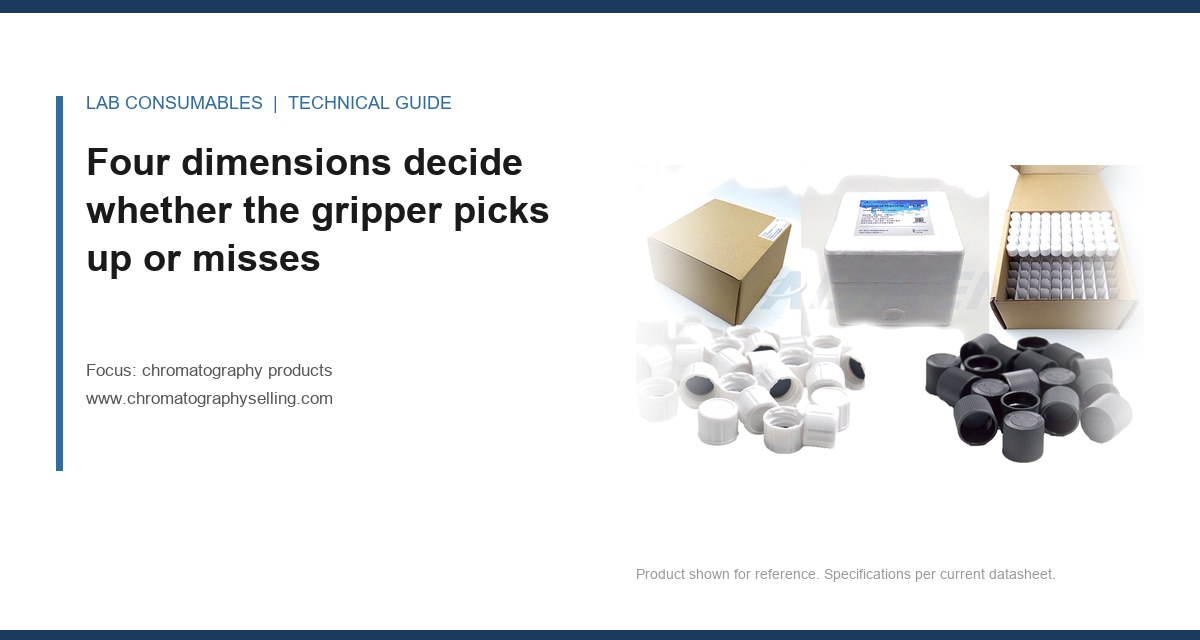
A 12-position autosampler on a Thermo AS3000 threw error 4102 (vial not found) on position 7 four times in a single 96-injection sequence. The tray was loaded correctly. The vial was seated. The cap was on. What was actually wrong: the tray had been swapped in without re-homing, so the Z-axis reference was 0.4 mm low, and the gripper was clipping the cap skirt instead of clearing it. That is a fit problem dressed up as a sensor problem, and it is the most common class of autosampler pickup error and misalignment I see in the field. The instrument reports a position fault. The root cause is a dimensional mismatch between the tray, the gripper, the cap, and the vial, and the fix lives in micrometers, not in firmware.
This article is about that class of failure specifically: the alignment and fit problems that surface as chromatography products failures when they are really geometry problems. If you are chasing a pickup error on an autosampler, the answer is almost never the sensor. It is one of four dimensions, and you can measure all four in under twenty minutes with a caliper and a depth gauge.
Every autosampler pickup comes down to the same four numbers. Get all four inside tolerance and the gripper works. Miss one and you get an error code that points somewhere else.
- Tray height (Z-reference): the vertical distance from the tray datum to the vial cap top. Nominal for most 2 mL autosamplers is 32.0 to 32.5 mm from the tray floor to the cap crown, with a tolerance of about ±0.3 mm. Outside that window the gripper either crushes the cap or grabs air.
- Gripper jaw tolerance: the open-jaw span and the closing force. Typical jaw span is 11.0 to 11.6 mm for a standard 11 mm crimp cap. Jaw wear of 0.2 mm changes the grip point enough to shift the vial laterally by 0.5 mm during lift.
- Cap seating depth: how far the cap skirt sits down over the vial neck. A properly seated 11 mm crimp cap leaves the skirt flush to within 0.2 mm of the neck shoulder. A 9 mm screw cap should bottom out with 0.8 to 1.2 N·m of torque on a calibrated driver.
- Vial OD and concentricity: 11.6 mm ± 0.2 mm for a standard 2 mL vial, with concentricity within 0.15 mm TIR. A vial that runs out 0.3 mm will foul the gripper on one side even when every other dimension is perfect.
If you want the full dimensional picture of the parts themselves, the chromatography products catalog lists the nominal specs, but the tolerance stack is what matters here, not the nominal.
Tray height is the number nobody re-checks after a tray swap
Tray height is where most pickup errors start. The tray is a mechanical reference, and mechanical references drift every time someone lifts it off the deck, swaps a 12-position tray for a 100-position tray, or slides a well plate adapter in.
Here is the mechanism. The autosampler homes the Z-axis against a fixed reference, usually a flag or a hard stop on the tower. The tray sits on a deck that has its own tolerance. When you swap trays, the deck-to-tray interface stacks two tolerances: the deck mounting tolerance (typically ±0.2 mm) and the tray manufacturing tolerance (typically ±0.3 mm). Stack them and you can be 0.5 mm off before a single vial is loaded. That is more than the entire Z-window on most instruments.
What the error codes actually tell you
Different vendors name the same fault differently, and knowing the code saves you a service call:
| Instrument family | Error code / message | Most likely dimension |
|---|---|---|
| Agilent 7693A / 7697A headspace | “Vial not found” or “gripper error” on a specific position | Tray height low by >0.3 mm, or cap crown above 32.5 mm |
| Agilent 1260 / 1290 autosampler | “Drawer error” or “tray not detected” | Tray not seated on the deck datum |
| Thermo AS3000 / TriPlus | Error 4102 “vial not found,” 4104 “gripper fault” | Gripper jaw wear or cap skirt interference |
| Waters 2707 / 2777 | “Vial missing” or “plate not present” | Well plate adapter height, not the plate itself |
| Shimadzu SIL-30AC | “Rack error” or “vial detection error” | Rack height or rack latch not fully engaged |
Notice that none of these codes say “tray height.” They say “vial not found” or “gripper fault.” The instrument is reporting the symptom, not the cause. Your job is to translate. A “vial not found” on a position that is visibly loaded is a height problem nine times out of ten.
The measurement that settles it
Put a depth gauge on the tray deck and measure to the top of a loaded cap. Do it at the four corners of the tray and the center. If the spread across those five points exceeds 0.3 mm, the tray is not seated or the deck is not level. If the average is below 32.0 mm, the Z-reference is low and the gripper will clip the cap. If it is above 32.5 mm, the gripper will grab air above the cap and report a missing vial.
Gripper tolerance wears quietly and fails loudly
The gripper is the part of the autosampler that gets the least attention and does the most work. A 100-position tray running 96 injections a day closes the jaws roughly 96 times per sequence. Over a year that is tens of thousands of cycles. The jaws wear, the closing spring relaxes, and the grip point shifts.
You cannot see jaw wear with the naked eye until it is already causing failures. Measure the open-jaw span with a pin gauge or caliper. New jaws on a standard 11 mm gripper run 11.0 to 11.6 mm. When the span drops below 10.8 mm, the jaws no longer clear the cap skirt on the way down and you get lateral displacement during lift. The vial tilts, the needle misses the septum center, and you get a bent needle or a partial injection.
The other gripper failure is closing force. A worn spring closes the jaws too slowly or not fully, and the vial slips during transport. The symptom is a vial that ends up in the wrong well or on the floor of the tray. If you are seeing vials displaced by more than one well position, suspect jaw spring fatigue before you suspect the tray.
Cap seating: the 0.8 mm that changes everything
Cap seating is where fit problems cross over into the analytical result. A crimp cap that is not fully seated sits 0.3 to 0.8 mm high on the neck. That is enough to change the cap crown height, which changes the Z-dimension the gripper sees. It is also enough to compromise the seal and let solvent evaporate between prep and injection.
For screw caps the number is torque. A 9 mm screw cap on a 2 mL vial should be torqued to 0.8 to 1.2 N·m. Below 0.8 N·m the cap is not bottomed and the crown sits high. Above 1.2 N·m you risk cracking the neck or deforming the septum. I have seen labs hand-tighten caps to wildly different values across a single tray, and the resulting cap-height spread of 0.6 mm was enough to trigger intermittent gripper faults on three positions out of ninety-six.
The fix is a calibrated torque driver and a seating check. If you are not sure your caps are seating consistently, the vials with caps reference covers the dimensional stack for common cap styles, and it is worth matching your cap spec to your gripper spec before you buy another case.
Two field cases where the error code lied
Case 1: the 0.4 mm tray that cost a week
Symptom: A Thermo AS3000 threw error 4102 on position 7 of a 96-injection sequence, four times in one run. Positions 1 through 6 and 8 through 96 ran clean.
Measurement: Depth gauge on the tray deck showed a 0.4 mm low reading at the front-left corner relative to the rear-right. The tray had been swapped in without re-homing, and the front-left corner was not fully seated on the deck datum.
Fix: Re-seated the tray, re-homed the Z-axis, and re-ran the sequence. Zero faults. The takeaway: a single low corner on a tray produces a position-specific error, not a global one, which is why it looked like a bad vial for a week.
Case 2: the cap skirt that fouled the jaws
Symptom: A Waters 2707 reported “vial missing” on a well plate adapter, but the plate was fully loaded. The gripper was grabbing the cap and dropping the vial back into the well.
Measurement: Caliper on the cap crown showed 33.1 mm from the adapter deck, above the 32.5 mm upper limit. The adapter was a third-party part with a deck height 0.6 mm taller than the OEM adapter.
Fix: Swapped to an OEM-height adapter and re-checked crown height at 32.3 mm. Faults stopped. The lesson: third-party plate adapters are a common source of tray height error because the deck height is not always held to the same tolerance as the instrument tray.
A pickup-error checklist you can run in twenty minutes
When an autosampler throws a pickup or misalignment error, work through these in order. Stop at the first one that fails.
- Measure tray height at five points. Spread must be under 0.3 mm, average between 32.0 and 32.5 mm. Fail: re-seat and re-home.
- Measure cap crown height on three loaded vials. Must be within ±0.3 mm of nominal. Fail: check cap seating and torque.
- Check cap torque with a calibrated driver. Screw caps 0.8 to 1.2 N·m. Fail: re-torque and re-check crown height.
- Measure gripper open-jaw span. Must be 11.0 to 11.6 mm. Fail: replace jaws.
- Check vial OD and concentricity on a sample of ten. OD 11.6 ± 0.2 mm, TIR under 0.15 mm. Fail: reject the lot.
- Check the tray latch is fully engaged. A latch that is 90% closed looks closed and is not.
- Re-home the instrument and run a single-position test before running a full sequence.
If all seven pass and you still get a fault, then it is worth looking at the sensor. In my experience that is the last place to look, not the first.
Why third-party parts are the usual suspects, and when they are fine
Third-party vials, caps, and trays are not inherently a fit problem. The issue is that the tolerance stack is only as good as the weakest part, and a third-party part that is nominally identical can be 0.3 to 0.6 mm off on the one dimension that matters. The OEM holds the tray deck height to a tighter tolerance than most aftermarket suppliers because the OEM designed the gripper around it.
That does not mean you should only buy OEM. It means you should measure the parts you buy against the four dimensions above before you put them into a running sequence. A supplier that publishes its dimensional tolerances (and holds them to ±0.2 mm on OD and ±0.3 mm on height) is a supplier you can use. A supplier that publishes nominal dimensions only is a supplier you have to qualify yourself. The vial supplier guidance covers what a qualification record should contain, and if you are sourcing from a manufacturer, the Aijiren technical pages list the dimensional tolerances for their vial and cap lines.
For instrument-specific tray and gripper specs, the vendor documentation is the authority. Agilent publishes tray and gripper dimensions in its GC columns and accessories documentation, and Thermo publishes autosampler tray specs in its chromatography and sample handling literature. Restek’s technical resources are also a useful cross-check for vial and cap dimensions across instrument families. If your method is tied to a regulatory framework, the container dimensions in EPA SW-846 methods are a useful sanity check, though the autosampler fit problem is a mechanical issue, not a regulatory one.
What to do differently on the next tray load
The decision rule is simple. Before you put a tray into a running sequence, measure the tray height at five points and confirm the spread is under 0.3 mm and the average is between 32.0 and 32.5 mm. If it fails, re-seat and re-home before you run. Do not run a sequence and hope. A pickup error on position 7 costs you the whole sequence, and a bent needle costs you a service call.
The second rule: when you see a “vial not found” or “gripper fault” error, do not replace the vial. Measure the cap crown height, the gripper jaw span, and the tray height, in that order. The error code tells you the instrument could not pick up a vial. It does not tell you why, and the why is almost always a dimension, not a sensor. Keep a depth gauge and a pin gauge next to the instrument. They cost less than one service call and they will find the fault in twenty minutes.
References & further reading
Related resources from our lab consumables network:
- Chromatography Products at chromatographyselling.com
- Aijiren at aijirentech.com
- Vials With Caps at vialswithcaps.com
- Vial Supplier at vialsupplier.com
External references and standards: