
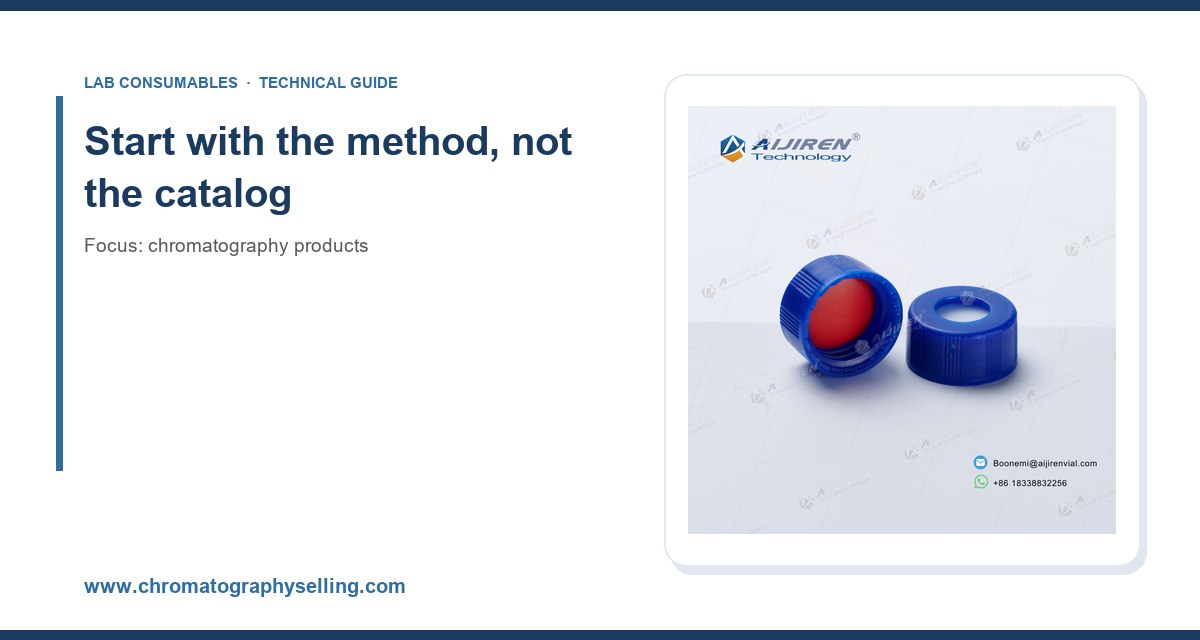
I have watched a lab burn through a full case of 2 mL autosampler vials in three weeks because somebody bought the cheapest septa on the quote, and the 9 mm silicone discs coring into the needle turned every sequence into a game of “find the phantom peak.” I have also seen the opposite mistake: a buyer specifying PTFE-lined caps with the thickest septum available for a method that ran at 40 °C and never needed them, paying roughly 2.5x the unit price for zero analytical benefit. Choosing chromatography consumables is not a shopping exercise. It is a matching problem between your instrument, your method conditions, and the physical chemistry of the sample. Get the match right and the column lasts its rated injection count. Get it wrong and you will spend more on troubleshooting than you saved on the purchase order. Below is how I evaluate products across the main categories, with the numbers I actually use.
Before you open any supplier page, write down five parameters for every method you run: mobile phase composition and pH, maximum operating pressure, column oven temperature, injection volume, and sample matrix. Those five numbers eliminate about 70% of the catalog immediately. A method running 0.1% formic acid at pH 2.7 with a 400 bar ceiling does not need a 1,200 bar ultra-high-pressure column, and buying one wastes money while sometimes making the separation worse because the particle size changes the selectivity you validated.
I keep a one-page “method card” per assay taped inside the solvent cabinet. It lists the column part number, the guard cartridge part number, the vial and cap part numbers, and the septum type. When someone reorders, they copy from the card, not from memory. This single habit cut our wrong-part orders by more than half.
The five questions that drive every purchase
- What is the pH range? Standard C18 silica columns are stable from about pH 2 to 8. Outside that window you need hybrid particles (pH 1 to 12), polymeric sorbents, or a different chemistry entirely. Running pH 10 on a conventional C18 dissolves the silica bed and shifts retention within a few hundred injections.
- What is the maximum pressure? A 5 µm particle column at 2.1 mm ID is happiest below 400 bar. A 1.7 µm particle at the same ID will run at 800 to 1,000 bar. Your pump and your fittings must match the column, not the other way around.
- What is the injection volume relative to column ID? On a 2.1 mm ID column, keep injections at or below 2 µL of aqueous sample. Above that you get peak distortion from solvent strength mismatch. On a 4.6 mm ID column, 10 to 20 µL is normal.
- What is the detection mode? UV at 210 nm punishes any mobile phase with UV cutoffs above that wavelength. LC-MS punishes non-volatile buffers. Both punish phthalate contamination from plastic labware.
- What is the sample matrix? Plasma, soil extracts, and beverage samples need different filtration and different vial chemistry. A 0.22 µm PVDF filter is fine for aqueous samples and a poor choice for certain organic solvents.
Columns: the decision that sets everything else
The column is the most expensive consumable per unit and the one most likely to be over- or under-specified. I evaluate columns on four axes: particle size, dimensions, stationary phase chemistry, and endcapping/ligand density.
Particle size and pressure
Particle size drives both efficiency and backpressure. Going from 5 µm to 3 µm roughly halves the plate height and increases backpressure by a factor of about 2.8 at the same flow and column length. Going to sub-2 µm particles multiplies pressure again. The practical rule I use: if your system cannot hold 600 bar comfortably, stay at 3 or 5 µm. If you have a modern UHPLC with 1,000 bar capability, sub-2 µm particles give you faster runs and better resolution per unit time, but you must also switch to low-dead-volume fittings and shorter connection tubing (0.005 inch ID or less) or you lose the gain to extra-column dispersion.
Dimensions and loadability
A 4.6 x 150 mm column holds roughly 5x the mass load of a 2.1 x 100 mm column. If you are doing trace analysis with UV detection, the narrower column concentrates the peak and improves sensitivity. If you are doing preparative or semi-prep work, you need the wider bore. For most routine QC methods on legacy HPLC systems, 4.6 x 150 mm at 5 µm is still the workhorse, and it is the format most pharmacopeial methods were validated on. Do not switch dimensions without revalidating, because selectivity changes and your system suitability criteria may fail.
Chemistry and endcapping
A “C18” is not a single thing. Ligand density, endcapping, and the base silica (Type B, high-purity, low metals) determine how a column behaves with basic analytes. For basic compounds, a well-endcapped C18 reduces silanol interactions and tailing. For acidic compounds at low pH, endcapping matters less. If you are developing a method from scratch and want a starting point, a high-purity Type B silica C18 with full endcapping is the safest default. If you are transferring a validated method, buy the exact part number from the original method, not a “comparable” column, unless you plan to revalidate.
Guard columns: cheap insurance
A guard cartridge costs roughly 10 to 15% of the analytical column price and extends column life by 2 to 5x in dirty matrices. I have seen soil extracts destroy an unprotected column in under 200 injections. The same method with a guard cartridge ran past 1,500 injections. Buy the guard holder once and keep a stock of cartridges. Change the cartridge when peak shape degrades or backpressure climbs 15% above baseline, whichever comes first.
For a broad look at what is available across column chemistries and formats, the Agilent chromatography consumables and columns catalog is a useful reference for part numbers and specifications, and Restek technical resources has application notes that show real chromatograms for specific chemistries.
Vials, caps, and septa: where most money is quietly wasted
This is the category buyers most often treat as a commodity, and it is the one that generates the most phantom peaks, needle coring, and autosampler jams. I have strong opinions here.
Glass: clear, amber, and the silanization question
Use clear glass for UV detection above 300 nm. Use amber glass for any analyte sensitive to light (many vitamins, some pesticides, and most photolabile drugs). For compounds that adsorb to active silanol sites on glass (amines, some peptides, certain basic drugs), use silanized (deactivated) glass. The cost premium is small and the recovery improvement can be large. I have measured recovery of a basic amine at 78% in untreated glass versus 96% in a silanized vial from the same sample. That is a real analytical error, not a rounding difference.
Septum selection: the numbers that matter
The septum is where coring happens. A 9 mm septum in a standard crimp or screw cap is punctured by the autosampler needle on every injection. Silicone septa core badly; PTFE-faced silicone septa core less because the PTFE face resists the needle. For a 100-injection sequence, a low-coring PTFE/silicone septum is worth the extra cents. For high-throughput labs running 500+ injections per day on the same vial position (rare, but it happens on some autosamplers), specify pre-slit septa or septumless caps. Pre-slit septa reduce coring but can allow evaporation on long sequences, so weigh the trade-off against your run time.
Temperature matters too. Standard silicone septa are rated to about 200 °C for short exposures but degrade faster above 150 °C. If your GC inlet runs at 250 to 300 °C, use high-temperature septa rated to 350 °C. A degraded septum bleeds siloxanes into the column and shows up as a rising baseline or ghost peaks at the front of the run.
Caps, threads, and torque
Most 2 mL autosampler vials use either a 9 mm screw thread (often called 9-425) or a crimp neck. Screw caps are more convenient and re-openable; crimp caps seal better for long storage and are preferred for volatile analytes. If you use screw caps, do not over-torque. Hand-tight plus a quarter turn is enough for most; a torque of about 0.5 to 0.8 N·m is a reasonable target if you use a torque tool. Over-torquing deforms the septum, creates a permanent channel, and causes evaporation or needle damage. I have seen autosampler needles bend because a cap was cranked down so hard the septum bulged into the vial neck.
For crimp caps, the crimper setting matters. An over-crimped aluminum seal can crack the glass neck; an under-crimped seal leaks. Practice on empty vials and check that the cap spins freely but does not lift. Standard 11 mm crimp caps are the most common format for 2 mL vials.
Where to source
Vial quality varies more than people expect. Dimensional tolerance on the neck and the septum thickness both affect autosampler reliability. A vial that is 0.3 mm out of spec on neck height can cause the needle to bottom out or miss the septum. I buy from suppliers who publish dimensional tolerances and lot traceability. For 2 mL and 4 mL formats with matched caps and septa, vials with caps is a practical starting point, and for bulk and custom orders vial supplier carries the common 9-425 and 11 mm crimp formats. If you need a broader catalog across columns, vials, filters, and syringes in one place, chromatography products at chromatographyselling.com is organized by application rather than by brand, which saves time when you are building a method from scratch.
Filters and syringes: the step that ruins more runs than any other
Sample filtration is where I see the most avoidable damage. A 0.45 µm filter is not fine enough for sub-2 µm columns; use 0.22 µm for any column with particles under 3 µm. The filter membrane chemistry must be compatible with your solvent. PVDF is good for aqueous and many organic samples but swells in some solvents. PTFE is chemically inert and good for aggressive solvents but hydrophobic, so it needs a pre-wet with an organic solvent for aqueous samples. Nylon adsorbs proteins and some basic compounds; avoid it for peptide work. Cellulose acetate is low-binding for proteins but not solvent-resistant.
Filter diameter affects recovery. A 13 mm syringe filter holds less dead volume than a 25 mm filter, so for small sample volumes (under 1 mL) use the smaller diameter to reduce loss. For viscous samples, the larger diameter reduces backpressure and prevents the membrane from rupturing. I standardize on 13 mm, 0.22 µm PVDF for aqueous LC samples and 13 mm, 0.22 µm PTFE for GC and aggressive-solvent samples.
Syringe and needle selection
Autosampler syringes are a wear item. A 10 µL syringe with a 23-gauge needle is standard for most LC autosamplers; a 10 µL with a 26-gauge needle is common for GC. The needle gauge must match the septum and the vial. A 26-gauge needle on a thick septum cores more easily than a 23-gauge. Replace syringes when the RSD of replicate injections exceeds 2% for a well-behaved analyte, or when you see visible scratches on the barrel. Keep a spare on the shelf; a failed syringe mid-sequence costs more in lost time than the part.
Mobile phase and solvent handling consumables
Solvent quality is a consumable decision. HPLC-grade solvents are filtered to 0.2 µm and have low UV cutoffs; ACS grade is not. For UV detection at 210 nm, use HPLC-grade acetonitrile or methanol and check the lot certificate for absorbance at your wavelength. For LC-MS, use LC-MS grade with low metal content and low particle count. I have seen a single lot of “HPLC grade” water with a UV cutoff above 210 nm ruin a week of runs.
Inline filters and solvent frit filters are cheap and prevent pump damage. Replace the solvent frit every 3 to 6 months, or sooner if you see particles. Use a 0.2 µm inline filter between the pump and the injector if your system does not have one. Degassing matters too: helium sparging or vacuum degassing prevents bubbles that cause baseline noise and pump cavitation. For a 1 L mobile phase bottle, 10 to 15 minutes of vacuum degassing is usually enough; helium sparging at 20 to 30 mL/min works but wastes helium.
Detectors and flow cells: match the cell to the application
If you are buying a UV detector or replacing a flow cell, the cell path length and volume matter. A standard 10 mm path length, 8 to 14 µL cell is fine for 4.6 mm columns. For 2.1 mm columns, use a smaller-volume cell (2 to 5 µL) to reduce extra-column dispersion. For capillary or nano-LC, you need a dedicated cell. A mismatched cell is a common cause of peak broadening that people blame on the column.
For RI detection, temperature stability is everything. A 0.001 °C drift in the cell causes baseline drift. For fluorescence, check the lamp hours and replace before the signal-to-noise drops below your method requirement. For MS, the source and the cone are the wear parts; clean them on a schedule based on injection count, not on when the signal drops.
Gas chromatography specifics
GC consumables have their own rules. Inlet liners are the most frequently replaced part. Use a deactivated liner for active analytes; use a liner with glass wool for dirty samples to trap non-volatile residue. Replace the liner every 100 to 200 injections for dirty matrices, or when peak shape for early-eluting compounds degrades. The septum, as noted, must match the inlet temperature. Ferrules must match the column OD and the nut; a graphite ferrule seals well but can loosen with thermal cycling, while a graphite/Vespel ferrule holds better at high temperature. Retighten ferrules after the first few temperature cycles.
Carrier gas purity matters. Use 99.999% helium or hydrogen with a gas purifier. An oxygen trap and a moisture trap are not optional for a column you expect to last. A single oxygen exposure at high temperature can strip the stationary phase and shorten column life dramatically.
For method references on GC and LC consumable selection, the Thermo Fisher chromatography and sample handling pages have application-specific guidance, and the U.S. EPA SW-846 test methods define the consumable and quality control requirements for many environmental methods, which is a good reality check when a supplier claims a product is “method compliant.”
Decision checklist with concrete numbers
Use this as a pre-purchase checklist. If you cannot answer a line, you are not ready to order.
- Column pH range: confirm the method pH is at least 0.5 units inside the column’s rated range. Conventional C18: pH 2 to 8. Hybrid: pH 1 to 12.
- Column pressure: confirm the method’s maximum pressure is at least 20% below the column’s rated limit and the system’s limit. Example: 400 bar method on a 600 bar column and a 600 bar pump.
- Particle size vs. system: sub-2 µm only if the system is rated 1,000 bar and has low-dispersion plumbing. Otherwise 3 or 5 µm.
- Guard column: budget one guard cartridge per 200 to 500 injections for clean matrices, one per 100 to 200 for dirty matrices.
- Vial format: 2 mL, 9-425 screw or 11 mm crimp. Confirm autosampler tray compatibility before ordering 1,000 units.
- Septum: PTFE/silicone for LC, high-temperature silicone (rated 350 °C) for GC inlets above 250 °C. Pre-slit only if evaporation is not a concern.
- Cap torque: 0.5 to 0.8 N·m for screw caps. Hand-tight plus a quarter turn if no torque tool.
- Filter: 0.22 µm for columns under 3 µm; 0.45 µm acceptable only for 5 µm columns and only for clean samples.
- Filter membrane: PVDF for aqueous LC, PTFE for GC and aggressive solvents, nylon only for non-protein aqueous samples.
- Syringe RSD: replace when replicate RSD exceeds 2% for a well-behaved analyte.
- Solvent grade: HPLC grade for UV below 220 nm; LC-MS grade for MS detection.
- Frit and inline filter: replace every 3 to 6 months or when backpressure rises 15%.
Troubleshooting checklist: symptom to cause
When a run goes bad, work from the injector outward. Most problems are upstream of the column.
- Phantom peaks at the front of the run: septum coring, contaminated mobile phase, or a dirty inlet liner in GC. Replace the septum and the liner, then re-run a blank.
- Rising baseline: detector lamp aging, septum bleed at high inlet temperature, or mobile phase evaporation. Check lamp hours and septum rating.
- Peak tailing for basic analytes: silanol interactions (use an endcapped column or a silanized vial), or a guard cartridge that is exhausted.
- Loss of resolution: column voiding from pH outside the rated range, or a guard cartridge that has channeled. Check the method pH first.
- High backpressure: partially blocked frit, precipitated buffer (flush with 10% aqueous then organic), or a guard cartridge that needs replacement.
- Inconsistent injection volumes: syringe wear, a partially cored septum, or a cap that is not seated. Replace the syringe and check cap torque.
- Ghost peaks in GC: carryover from a dirty liner or a septum that is bleeding. Replace both and bake out the column.
What I recommend
For a general-purpose LC lab running reversed-phase methods between pH 2 and 8 with UV detection, I would standardize on a 4.6 x 150 mm, 5 µm, high-purity Type B silica C18 column with a matching guard cartridge, 2 mL clear 9-425 screw vials with PTFE/silicone septa, 13 mm, 0.22 µm PVDF syringe filters, HPLC-grade acetonitrile and water, and a 10 µL autosampler syringe with a 23-gauge needle. That kit covers the majority of routine work, keeps consumable costs predictable, and is easy to reorder by part number. For LC-MS work, swap to LC-MS grade solvents, a 2.1 x 100 mm column with 1.7 or 1.8 µm particles if the system supports the pressure, and a smaller-volume flow cell. For GC, add high-temperature septa, deactivated liners, and graphite/Vespel ferrules, and change the liner on an injection-count schedule rather than a calendar schedule.
If you are building a method from scratch and want a single source to compare formats and part numbers, the Aijiren catalog covers columns, vials, and filtration in the common formats, and the chromatography products index at chromatographyselling.com groups them by application so you can match a kit to a method rather than assembling parts one at a time.
The takeaway is simple: specify consumables against the five method parameters, not against price per unit. The vial and septum you choose can cost you a column, and the column you choose can cost you a revalidation. Match the part to the method, keep a method card taped inside the solvent cabinet, and reorder by part number. That discipline is worth more than any single product upgrade.
References & further reading
Related resources from our lab consumables network:
- Chromatography Products at chromatographyselling.com
- Aijiren at aijirentech.com
- Vials With Caps at vialswithcaps.com
- Vial Supplier at vialsupplier.com
External references and standards: